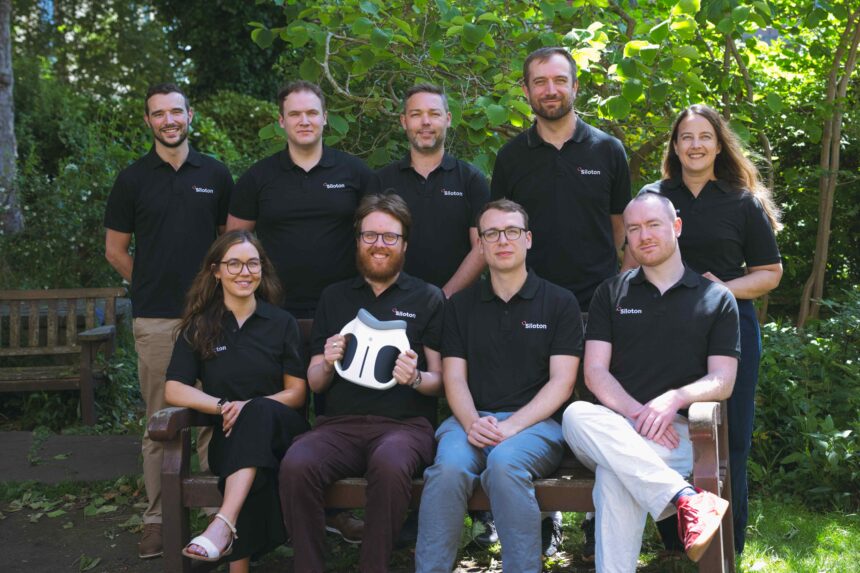
Siloton has been awarded a contract to accelerate development of its handheld eye imaging system, making detection and monitoring of retinal diseases more accessible.
The med-tech start-up has secured £8.4 million from Innovate UK, part of UK Research and Innovation (UKRI), through its Contracts for Innovation: Quantum Missions Primer initiative. The programme supports public sector organisations in solving some of their most complex challenges by running competitive funding opportunities to develop new technologies.
Over two years, the contract will help Siloton accelerate the design of the in-clinic and at-home versions of its GiraffeOCT optical coherence tomography (OCT) device and complete trials on both systems. The start-up expects the funding could cut the development process by up to two years.
Siloton will collaborate with Sunderland Specialist Eye Hospital on clinical trials over the course of the contract for its in-clinic device, providing patients across the North East and North Cumbria access to the technology during its development. Additionally, York Health Economics Consortium will use this data to refine its cost-saving estimates for the NHS.
The project will create a number of high-skilled jobs over the next two years, supporting the miniaturisation of the system’s electronics, product development, and manufacturing plans across specialisms including photonics, electronics, and software development.
The company plans to raise further investment following the contract win, strengthening its cash position for the next few years and supporting the development of its second-generation CheetahOCT device, designed to measure different layers of the retina and expand the number of conditions it can detect.
Alasdair Price, CEO of Siloton, said, “Winning this Innovate UK contract allows us to accelerate the development of our systems, explore manufacturing and assembly in the UK, and help a groundbreaking new technology be adopted by the NHS more quickly. Many early-stage companies struggle to get beyond the well-known ‘valley of death’ in developing new products – particularly in healthcare – but this will support us through that crucial phase, bringing the Siloton system closer to being in patients’ hands and building a technology that can be used worldwide.”
OCT uses light to create detailed pictures of the inside of the eye, enabling clinicians to identify a range of health conditions and monitor their progress over time. However, its use is limited because existing systems are large, expensive, and often available only in hospitals and optometry clinics, which limits access, particularly for people in rural and remote communities.
As a result, ophthalmology is the busiest NHS outpatient speciality, with around nine million attendances in England during 2023/24. At the end of July 2026, nearly 623,000 people were on the waiting list for an appointment, representing 8.7% of all NHS waits.
Siloton’s GiraffeOCT is an easy-to-use, binocular-style system that makes diagnosing and monitoring a range of treatable retinal diseases more affordable and accessible, compressing a tabletop’s worth of heavy, expansive, fragile components onto a single chip.
The UK Government is aiming to move healthcare from a hospital-centric model into local communities. As part of its National Quantum Strategy Missions announced in 2023, it committed to NHS Trusts benefitting from quantum sensing-enabled solutions by the end of the decade, helping people with chronic illnesses live healthier, longer lives through early diagnosis and treatment.
Price added, “Developing the in‑clinic and at‑home versions of the system will help the government meet its ambitions of moving care into the community and bringing quantum technologies into the NHS. The contract will also allow us to expand our technology to cover a wider range of diseases, integrate our second‑generation BlueJay chip – the same architecture used in our system for astronauts – and build out the cloud platform that underpins the service.
“The NHS needs new technologies and new ways of working, and it needs them quickly. This contract is a first step toward streamlining the process and ensuring patients in the UK get access to the same innovations as other countries, as soon as they are deployed rather than years after approval.”