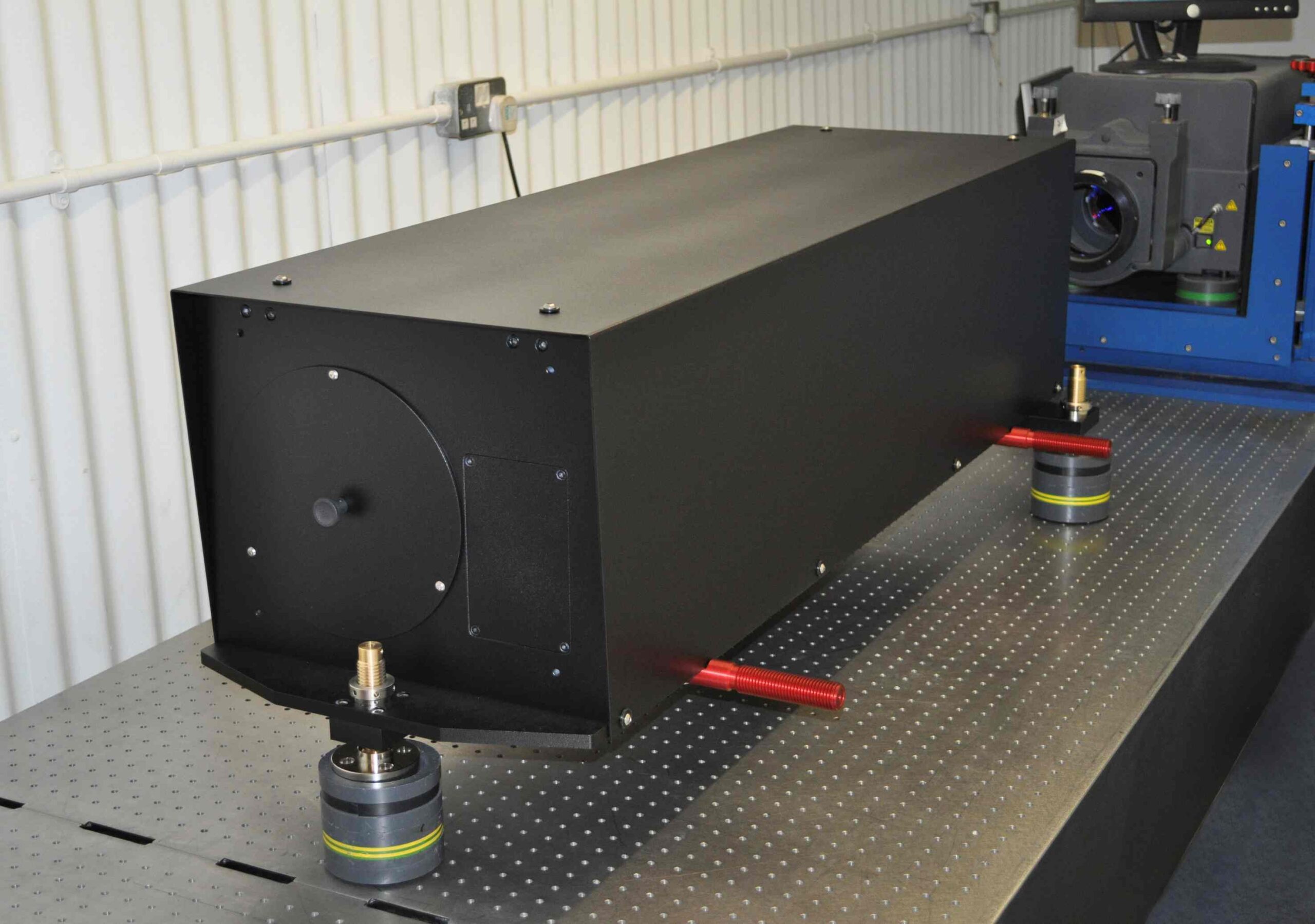
A new technique will help with testing of large diameter military optical systems
High precision optical components specialist Optical Surfaces Ltd has developed a new approach, using a series of pre-aligned beam collimator sub-assemblies, for Modulation Transfer Function (MTF) testing of large diameter military optical systems.
MTF is a technique, trusted by optical designers, for objectively evaluating the image-forming capability of military optical systems.
As reflective beam collimators can be used to replicate a target at infinity or interim distances without parallax, they are the device of choice for performing MTF measurements.
However, to test larger diameter military optical systems (> 250mm), or those requiring an MTF system delivering longer focal length focusing, traditionally required an extremely large, heavy and expensive reflective beam collimator system.
Dr Aris Kouris of Optical Surfaces Ltd said: “drawing upon decades of producing high performance reflective beam collimators our R&D team has come up with a novel way of addressing this challenge. We can now supply large collimators as sub-assembly kits that include a mounted off-axis parabolic mirror and a mounted folding flat that are easily assembled directly onto a standard optical table.
"Supplied pre-aligned at our production testing facility, once assembled a fine alignment tool allows the customer to quickly and accurately locate the focal plane and centre of the field. As an option, if required, we can also supply a protective cover to fit over your assembled beam collimator system”.
Optical Surfaces beam collimator kits combine high stability and high performance, according to the company, with a solution for testing larger diameter or long focal length military optical systems.
The high stability and performance of these new reflective beam collimator kits is achieved using a zero-expansion parabolic mirror, manufactured to better than lambda/10 p-v surface accuracy.
The off-axis design of Optical Surfaces modular beam collimators produces no central obscuration thereby ensuring highly efficient transmission is obtained. The all-reflecting design of these beam collimators is achromatic and with aluminium / magnesium fluoride coatings can operate from the UV to the infrared without adjustment.