In this article, Germany-based research society the Fraunhofer Institute Fraunhofer Institute for Manufacturing Engineering and Automation (IPA) in Stuttgart, one of Europe’s leading institutes for cleanroom technology, contaminant analysis, and air purity analysed the Luftilterbau Hepa filters.
It analysed VOC, SVOC and fogging in cleanroom and pharmaceutical air filtration and its results explain why Luftfilterbau believes the HS-Mikro SF-AL H14 PTFE Is the answer to an often overlooked problem.
The underestimated problem: chemical contamination from the filter itself
When selecting a HEPA filter for cleanroom, pharmaceutical production, or surgical environments, the conversation typically revolves around familiar parameters: filtration efficiency, pressure drop, rated airflow. What is rarely asked: what does the filter itself emit?
Filter media, adhesives, sealants, and frame components can release gaseous organic compounds into the airstream — invisible, odourless, but potentially critical for sensitive processes. In cleanroom technology and air purity engineering, these emissions are captured in three key categories:
- VOC (Volatile Organic Compounds) — volatile organic compounds with a boiling point up to approximately 250 °C. Typical sources within filters include solvent residues, plasticisers, and monomers from adhesive components. VOC emissions are relevant for pharmaceutical GMP environments, semiconductor manufacturing, and medical cleanrooms.
- SVOC (Semi-Volatile Organic Compounds) — semi-volatile organic compounds (boiling point 250–400 °C). This substance class includes phthalates, flame retardants, and higher-molecular adhesive residues. SVOCs persist longer in the air and can deposit on surfaces.
- Fogging / condensables — heavy semi-volatile organic substances that settle as an invisible film on optical components, sensor surfaces, or production goods. In semiconductor technology (ACC: Airborne Chemical Contamination), precision optics, and sterile filling lines, fogging can lead to rejects, calibration errors, and validation failures.
Additionally, Refractories — organic compounds containing heteroatoms such as silicon, nitrogen, sulphur, or phosphorus — pose a particular risk. Siloxanes, a subgroup of refractories, can damage coatings, lacquers, and electronic components even in trace quantities.
Fraunhofer IPA Stuttgart: Independent Emission Analysis to ISO 16017-1
The analysis comprised:
- VOC + SVOC to ISO 16017-1 (ATD-GC/MS, parameters according to VDA 278) — measurement immediately after unpacking (0–1 h) and after three days of continuous operation
- Condensables / fogging to VDI 2083 Part 22 (draft) and ISO 16000-6 — exposure over three days, with and without initial purge interval
- Measurement at a practical air velocity of 0.45 m/s in a real filter test setup
- Classification according to ISO 16017-1 and the stringent Zeiss SMT scheme (industry-standard classification for cleanroom emission analysis)
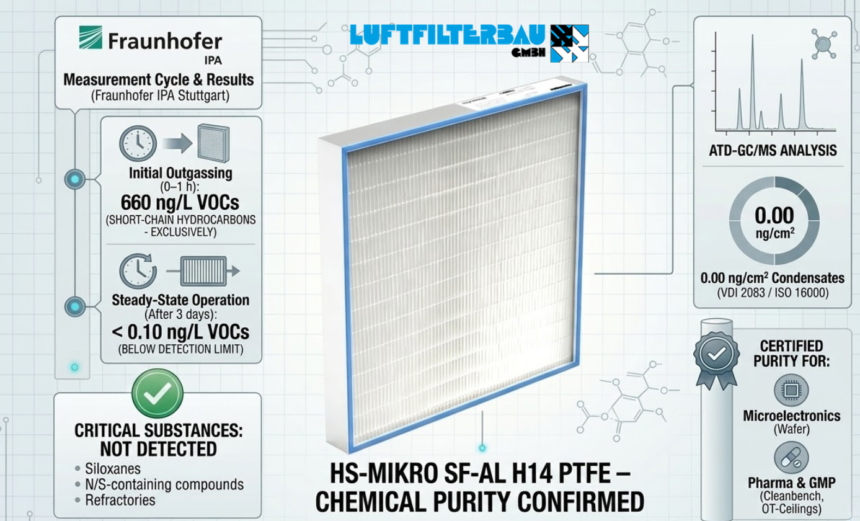
The results: zero steady-state emissions – zero condensables
VOC and SVOC
Time Point Total Emission (ng/L) Refractories Siloxanes Condensables 0–1 h (initial) 660 < 0.10 < 0.10 660 After 3 days < 0.10 < 0.10 < 0.10 < 0.10
In the initial measurement window directly after unpacking, 660 ng/L of organic compounds were detected. These are exclusively short-chain volatile hydrocarbons, contain no refractories or siloxanes whatsoever, and are fully dissipated within a few hours of operation. After three days of continuous operation, all measured values fall below the limit of quantification of 0.10 ng/L — analytically equivalent to zero.
Condensables (Fogging)
Exposure Window Condensables (ng/cm²) Refractories Siloxanes t = 0 h – 3 d 0.00 0.00 0.00 t = 2 h – 3 d 0.00 0.00 0.00
Both exposure windows returned 0.00 ng/cm² — absolute zero, far below any relevant detection threshold. No semi-volatile deposits. No fogging. No surface film.
Not accidental – the result of uncompromising materials selection and manufacturing precision
This result is not a given. Many HEPA filters on the market contain adhesives, sealants, or potting compounds that continuously release VOC or SVOC under operating conditions — often below the threshold of perception, but measurable and cumulatively relevant.
In developing our PTFE filter product line, every raw material and every manufacturing step was evaluated from the perspective of chemical purity. This includes the selection of filter media, potting compounds, sealants, and bonding materials. Decades of experience in nuclear, pharmaceutical, and cleanroom filtration have shaped this expertise.
Fraunhofer IPA measured is the result of that work.
Applications where chemical cleanliness is critical
The HS-Mikro SF-AL H14 PTFE is designed for laminar flow environments, surgical ceiling systems, and cleanbenches — applications where the chemical integrity of supply air is just as important as particulate filtration efficiency. Typical areas of use:
- Pharmaceutical production (GMP, EU GMP Annex 1)
- Cleanrooms ISO Class 1–6
- Microelectronics and semiconductor manufacturing (ACC-sensitive processes)
- Medical facilities (operating theatres, intensive care, sterile production)
- Precision optics and sensor manufacturing
- Biotechnology and laboratory environments
Transparency as standard: Test report available on request
The Fraunhofer IPA test report will be made available to qualified parties on request — for validation documentation, supplier qualification, or independent risk assessment.
Tested product: HS-Mikro SF-AL H14 PTFE, A/N: 40-11701170-R109C596
Testing institute: Fraunhofer IPA Stuttgart, Report No. HS 2026-194, March 2026
Test methods: ISO 16017-1, VDA 278, VDI 2083 Part 22, ISO 16000-6