The plastic all-in-one plate minimises human error and optimises filling line efficiency
Settle plates have been the traditional method for measuring microbial contamination in the air of filling lines. The idea is that a small, petri dish-like tray sits among the turbulent airflow and busy movement of operators, collecting particles from the air and providing a semi-quantitative idea of the air conditions.
However, settle plates have their weaknesses, one being their susceptibility to human error. The plates are manually changed by an operator wearing thick gloves that cause reduced sensitivity, making it more likely that the plates could be accidentally dropped, mishandled or contaminated. It is also possible that the operator forgets to change the settle plates altogether.
Another issue is whether the method of collecting air particles onto a surface is even an accurate method to continuously measure air quality.
“Settle plates tend to be qualitative tools because it’s CFU per unit area per unit time as opposed to CFU per volume,” said Mark Hallworth, the global pharma and senior GMP advisor of the Life Sciences Division of cleanroom technology developer Particle Measuring Systems (PMS).
“Risk isn’t five minutes at the start of the batch, and it isn’t for ten minutes at the end of the batch. Your viable risk can occur at any point throughout the entire process."
In fact, air is directed away from settle plates and toward the air return, so the expectation that a representative sample of microbes will settle onto the plates is outdated and inaccurate.
“The settle plate is like a dead-end street where there is no airflow being able to go in, so it’s a point of the past,” said Marc Machauer, the OEM coordinator of PMS.
One updated method of continuous air monitoring by PMS puts an agar plate into a stainless-steel head, with airflow directed inside the head. The airborne particles are directed onto the plate, providing a quantitative measure of air quality.
The only downside to this method is the limited amount of time the stainless-steel head can accurately monitor air before needing to be replaced. While traditional settle plates offer up to four hours of air monitoring, the stainless-steel heads offer only 10 to 40 minutes.
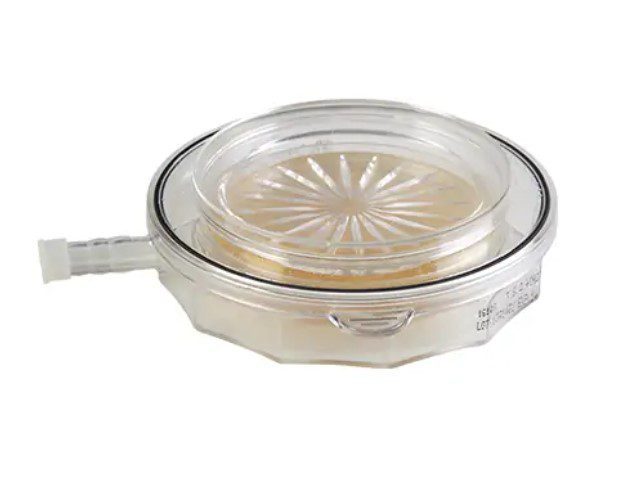
However, PMS has introduced a solution through its BioCapt Single-Use system. The system’s plastic head contains an agar plate already inside, optimising the continuous air monitoring process and controlling the humidity within the collection chamber. Protecting that chamber from the environment slows the desiccation rate and allows the plate to accurately and continuously collect air microbes for up to four hours.
There are two versions of the BioCapt Single-Use system. One can be replaced with one hand using an isolator glove, lowering the risk of clunky replacements, spilled plates and contamination. The second, more recently released version accommodates gloveless isolators, with a robotic arm changing the plates.
“This is still traditional microbiology,” said Hallworth. “This is still everything that we’ve had for the last 20, 30, 50 years, but we’ve evolved it into something that is now applicable to current technology.”