Fritiof Pontén and Anders Grahn explore the next generation of stand-alone inline degassers.
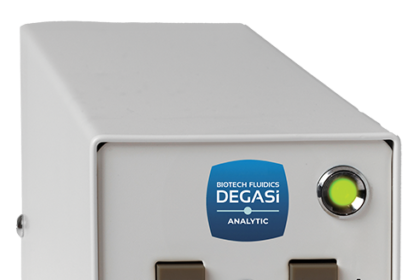
Inclusion of an inline degasser (see Figure 1) within a precision fluidic system is typically required to accomplish a reliable and robust output. This holds true regardless of whether the apparatus is designed for reagent dosing, in vitro diagnostics, next generation sequencing, liquid chromatography separations or other analytical instruments.
Without any degasser that remove dissolved gases, bubble formation often becomes a serious problem that affects flow accuracy, especially if the transported liquid is exposed to changes in temperature, pressure, or composition throughout the flow path. In contrast, a fluidic system with a properly designed inline degassing setup results in higher process precision, improved data accuracy, and shorter startup times.
Inline degasser design
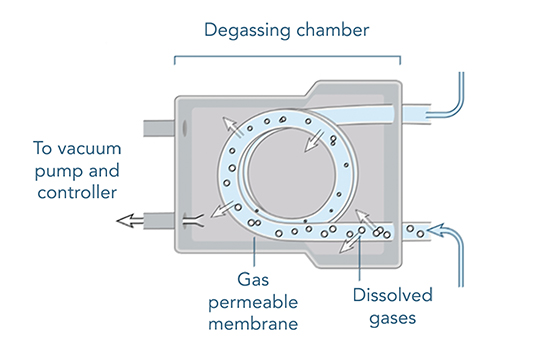
An inline degasser assembly contains a purposedly designed vacuum pump connected to one or several degassing chambers through which each liquid with dissolved gases flows. Inside the degassing chamber (see Figure 2) there is an inert, gas-permeable membrane that must be compatible with the liquid to be degassed. A control board with a vacuum sensor ensures that the vacuum level is kept at a constant level to minimise fluctuations in degassing performance and wear on the vacuum pump. Besides visual status feedback on the front panel, certain inline degasser designs can also communicate vacuum levels or convey error messages to external system software.
Extensive technology upgrade to inline degassers
The DEGASi program of stand-alone inline degassers manufactured by Biotech Fluidics has for decades been delivering top performing gas removal from liquids within fluidic systems in a wide range of flow rates. Recently the entire product program has gone through a full revision and extensive internal technology upgrade, whereby the improved DEGASi NG inline degasser family was born.
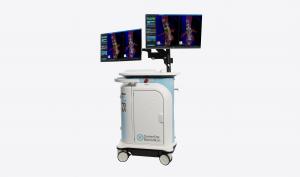
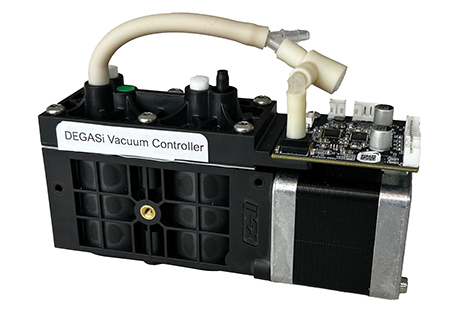
Specifically, the enhanced DEGASi NG constructions incorporate fifth generation StabiliX vacuum pumps and include the latest vacuum control technology with closed-loop regulation and advanced leak detection (see Figure 3). This results in superior vacuum stability, a lower acoustic profile for quiet operation and approximately 30% longer service life, according to the company. Every model in the DEGASi NG platform also comes with a standardised error control output that can automatically signal to a connected host system software, should the degasser not be functioning as expected. The popular slim housings of previous models have been retained, thus maintaining a minimum impact on occupied bench space.
New model launches with unique features
The upgraded DEGASi NG family contains several new degasser models with unique features that can be especially beneficial for specific applications as outlined below.
- The new DEGASi Analytic NG degasser (see Figure 1) covers flow rates from 0.2 to 2mL/min and thus fits perfectly to modern HPLC and UHPLC liquid chromatography instruments that operate with reduced column dimensions. Its unique PEEK-stented tubular flow path incorporated into a sturdy PPS chamber offers a completely metal-free flow path as well as excellent chemical inertness for a wide variety of mobile phase compositions, including hexanes and heptanes.
- The new DEGASi FlatFilm NG degasser incorporates a unique flat film degassing chamber based on a reinforced Teflon AF membrane that contain a significantly reduced amount of perfluoroalkylated (PFAS) polymers. This device provides double the degassing efficiency per unit volume and improved compatibility with viscous fluids and most organic solvents. Its extraordinary low flow resistance enables serial connection of up to five chambers, thereby extending the capacity from 6mL/min up to 30mL/min without loss of degassing efficiency.
- The new DEGASi LifeSci NG degasser employs a silicone-type tubular membrane that provides excellent degassing capabilities of aqueous solutions without liquid contact with any metals or polyfluoroalkyl substances (PFAS). The construction is designed to process aqueous solutions at flow rates from 5 up to 20mL/min and is thus highly suitable for environmental, food, healthcare, and biotechnology labs.
The full DEGASi NG product program [1] comprises 16 different models, each in a variety of configurations, thereby covering liquid flow rates ranging from 5µL/min up to 1L/min for any aqueous solution and many organic solvents.
Enhanced product lifecycle management
Maintenance of older degasser models from several manufacturers can also benefit from the technology upgrade of the DEGASi NG family. The core functionality of the DEGASi NG series stems from the DEGASi Vacuum Controller (see Figure 3), which is available as separate kits for different flow rate ranges and with a variety of vacuum setpoint levels, thus enabling maintenance and upgrades also of existing degasser installations.
References
[1] https://biotechfluidics.com/products/degassing-debubbling/degasi-inline-degassers/ (accessed September 6th 2026).
Authors
Dr. Fritiof Pontén, CEO, Biotech Fluidics AB, Onsala, Sweden Anders Grahn, Chairman & Founder, Biotech Fluidics AB, Onsala, Sweden
For more information visit: www.biotechfluidics.com