A practical investigation of gas uptake rates through different tubing types connecting an inline degasser and liquid pump in precision fluidic systems
Inline vacuum degassers (see Figure 1) are vital components within many types of equipment for laboratory analysis, including liquid chromatography, HPLC, UHPLC, ion chromatography, and mass spectrometry. Similarly, degassers are also critical constituents in fluidics systems used in immunology, haematology, in-vitro diagnostics, and semi-conductor manufacturing. In all these fluidic systems, inline degassers serve the role of silent guardians of precision and reliability by removing dissolved gases that could form bubbles which would disturb the fluid flow or recording of measurement signals. Inline degassing is consequently considered the most efficient and convenient ways to eliminate troubles with bubbles [1].
Comparing gas penetration through different tubing
An aspect that often may be overlooked, however, is the choice of tubing interconnecting the units throughout the fluidic system [2]. If the gas permeability across these flow lines is high, the influx of gases into the liquid could even nullify the benefit of the degasser and thus risk that the output shows poor precision and low accuracy. The factors that would be expected to influence to which extent this re-gassing could occur are the material properties, residence time, tube wall thickness, and exposed surface area.
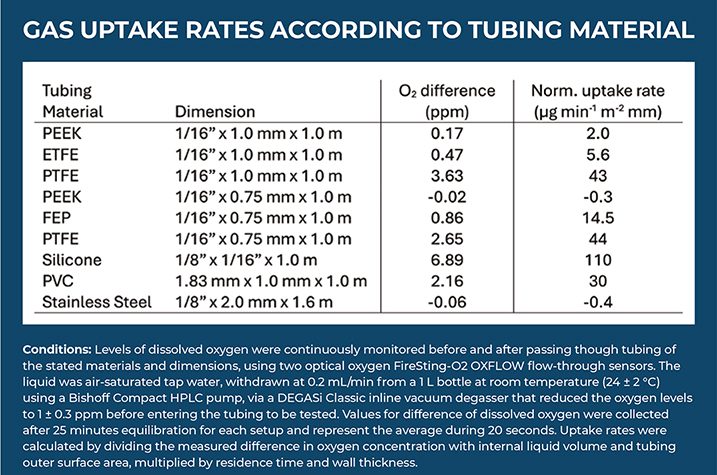
To investigate gas permeability, we conducted an experiment that continuously determined the changes in oxygen levels after passing different transfer tubing that were placed between a degasser and a withdrawing piston pump. The investigated tubing materials were polyetheretherketone (PEEK), polytetrafluoroethylene (PTFE), fluorinated ethylene propylene (FEP), and Ethylene tetrafluoroethylene (ETFE), all which had the same length (1 m) and outer diameter (1/16”), but varying inner diameters of 1.0 or 0.75 mm. Additional tubing materials, with other dimensions were also included, namely stainless steel, silicon and PVC (Tygon).
The content of Table 1 summarises the tested tubing materials and their dimensions plus recorded oxygen uptake through the walls of these flow paths. The increase in oxygen levels ranged from almost 7 ppm down to slightly negative values; the latter likely indicating the uncertainties in the present measurements. It was obvious from the recorded oxygen levels that thicker tubing walls significantly decreased the amount of penetrated gas. To compare materials across different tubing dimensions, we calculated gas uptake rate normalised to 1.0 mm tubing wall thickness. To allow quick comparison of gas uptake rate for different tubing materials, data from Table 1 was averaged for the different materials and plotted in a bar graph, see Figure 2.
Recommended tubing with degassers
The choice of tubing material did have a strong impact on the amount of gas that entered into the liquid flow path, thereby counteracting the benefits of degassing. Tubing wall thickness was also shown to be an important parameter to minimise re-gassing.
Silicone tubing showed particularly high tendencies of liquid re-gassing, followed by PTFE and PVC (Tygon) tubing. These types of tubing materials are therefore not suitable for precision fluidic systems other than in limited sections since their high gas permeability risk resulting in bubble formation even if an inline vacuum degasser is installed.
Although stainless steel tubing displayed zero gas permeability and PEEK only slightly higher, their rigidity and cost might limit the applicability in several applications. The tubing material that best met the criteria of low gas permeability, high flexibility, biocompatibility, and chemical inertness, was ETFE which displayed almost eight times lower gas uptake than PTFE tubing, and five time less than PVC tubing. A good compromise would also be FEP tubing which has limited gas permeability combined with an attractive price.
For more information visit: www.biotechfluidics.com
References
[1] “The Evolution of LC Troubleshooting – Degassing”, LCGC Europe, Dec. 2023, 36 (10), 397-401.
[2] Tubing Materials. https://biotechfluidics.com/products/tubing/ (accessed 2025-09-18)
Authors:
Dr. Magda Nyström, Product Specialist, Biotech Fluidics AB, Onsala, Sweden.
Anders Grahn, Chairman & Founder, Biotech Fluidics AB, Onsala, Sweden.
Dr. Tobias Jonsson, Diduco AB, Umeå, Sweden.