A head-to-head dataset from Integrated DNA Technologies shows that Anchored Multiplex PCR (AMP) sustains quality control (QC) and variant recovery where hybrid capture becomes input limited
FFPE tissue is the most common specimen type used for solid tumour profiling in many laboratories, but DNA extracted from FFPE is often fragmented, chemically modified, and available in limited mass. These characteristics directly stress the target enrichment step and, by extension, downstream QC, increasing the likelihood of QC failure, uneven coverage, reduced library complexity, and incomplete variant identification, especially when input mass is low. In an original white paper, of which this article is an abbreviated version, Integrated DNA Technologies compares two fundamentally different approaches for targeted DNA sequencing under matched sample types and stated inputs: Archer’s Anchored Multiplex PCR (AMP) chemistry VARIANTPlex Pan Solid Tumor (PST) v2 (Cat. No.AB0196) and VARIANTPlex Complete Solid Tumor (CST) v2 (Cat No. AB0198) with Archer Analysis and a hybrid capture approach illustrated by Illumina’s TruSight Oncology 500 (TSO500) v1 DNA (Cat. No. 20028213) paired with DRAGEN TruSight Oncology 500. The evaluation uses the same reference materials across a broad DNA input range and includes a deidentified FFPE tissue cohort tested at 40ng input.
In this dataset, the workflows show broadly comparable expected variant calling at higher inputs (≥40 ng), but the separation becomes pronounced as inputs become more constrained: under low input (≤10 ng) and poorer DNA integrity, AMP demonstrates fewer analysis QC failures and recovers a higher fraction of expected SNV/indel variants. Together, these findings indicate that AMP provides a wider functional operating range for degraded and low mass FFPE DNA than hybrid capture, supporting more consistent outcomes when specimens are limited or compromised.
AMP shows QC resilience when input is limiting
In this study, ‘QC failure’ follows each workflow’s default NGS QC rules applied to the sequencing data. Although the two pipelines do not use identical thresholds, the pass/fail outcomes remain directly relevant because they quantify how often each chemistry produces data that its own paired software considers acceptable for downstream interpretation.
Under the lowest input conditions, hybrid capture showed higher QC failure rates than AMP: for the low-quality inputs, failures were 57% with hybrid capture versus 21% with AMP; for the medium quality inputs, failures were 40% with hybrid capture versus 0% with AMP. In this dataset, 5ng and 10ng inputs did not meet key coverage and depth requirements for the hybrid capture workflow, suggesting that increasing input mass is the most practical route to restoring performance under those conditions. By contrast, within the low input AMP series, additional AMP outputs including coverage and outlier style metrics can support confidence in interpretation without necessarily requiring a full library repeat; the only explicitly described AMP failure in the lowest mass, poorest-integrity condition was linked to insufficient unique start sites.
An explanation based on the underlying chemistry used fits the QC pattern observed here. Hybrid capture depends on efficient probe hybridisation and recovery of sufficient unique molecules through capture and post capture amplification – steps that become increasingly template limited when DNA is both fragmented and scarce, and therefore more sensitive to reduced library complexity.3,7 AMP, by design, uses anchored, nested amplification to recover target signal from degraded templates through amplification rather than relying on capture dependent recovery, which can make performance more tolerant of fragmentation when input mass is constrained.6 Interpreted in this context, the QC outcomes observed here align with the expectation that chemistry choice becomes most consequential precisely where FFPE samples are most challenging: at low DNA integrity and low input mass.
AMP detects expected SNV/indel at 5–10 ng where hybrid capture drops expected sites
Sensitive variant detection from limited input is where differences in enrichment chemistry become most visible in assay onboarding decisions. In this study, ddPCR characterised variants in reference materials were used to define an ‘expected’ set of SNV/indel calls (variants present at ≥5% AF), providing an external methodology benchmark for detection while keeping the comparison constant in the same specimens and the same input mass series across both workflows.
Both workflows called all expected SNV/indel variants at higher inputs (notably ≥40 ng, data not shown), but performance diverged sharply at 5 ng and 10 ng. For the medium quality OncoSpan reference (15 expected SNV/indels), AMP called 98.9% at 5 ng and 100% at 10 ng, while hybrid capture called 57.8% at 5 ng and 82.2% at 10 ng. For the low-quality Severe reference (8 expected SNV/indels), AMP called 77.1% at 5 ng and 91.7% at 10 ng, while hybrid capture called 16.7% at 5 ng and 54.2% at 10 ng. Expressed as absolute differences, AMP recovered an additional 41.1 and 17.8 percentage points over hybrid capture for OncoSpan at 5 ng and 10 ng, and an additional 60.4 and 37.5 percentage points for Severe at 5 ng and 10 ng. Of note, while the reference standards include variants spanning a broad expected AF range (approximately ~1% to ~33% in manufacturer characterisations), the ‘expected’ set for the recovery analysis was defined using ddPCR at ≥5% AF.1,2 The magnitude and consistency of these differences across a low input series with triplicate library preparation can rule out sampling variation as the primary driver and instead support a systematic difference in how the two chemistries preserve detection when usable template molecules are limited.
A chemistry consistent interpretation is that hybrid capture becomes ‘molecule limited’ as DNA mass drops and fragmentation increases thereby fewer intact, unique template molecules are recovered efficiently through capture, which can lead to uneven target recovery and dropout at some expected sites.3,7 By contrast, AMP’s anchored, nested amplification is designed to recover target signal from degraded templates through amplification, consistent with the higher expected variant recovery observed here under challenging inputs.6 These results support AMP as a natural fit for poor quality and low quantity FFPE workflows, not only as a rescue method after capture fails, but as a primary approach when limited inputs are anticipated.
Comparing AMP allele frequency (AF) concordance
Beyond detection, many laboratories also assess whether observed AFs track an external expectation closely enough to support consistent thresholds for review and reporting. In Figure 4, ddPCR expected AFs for the Severe reference at 10ng input are compared with observed AFs from each workflow for the variants it detected. In this poor integrity, low input condition, the dataset shows stronger concordance between ddPCR and AMP (VARIANTPlex) than between ddPCR and hybrid capture (TSO500 V1 DNA). This pattern is informative because AF distortion commonly happens when coverage is sparse or when expected sites drop out, forcing estimates to be derived from fewer unique molecules and less stable sampling. Consistent with the detection results at low input, improved recovery of expected sites in the AMP workflow provides a plausible basis for the tighter ddPCR to observed AF relationship, because more complete and more even sampling reduces the likelihood that AFs are skewed by under sampling. Taken together, Figure 4 adds a complementary conclusion to the expected variant recovery data: under constrained FFPE inputs, AMP not only detects more of what should be present, it also yields Afs that more closely reflect an orthogonal ddPCR benchmark for the variants recovered, supporting more stable quantitative interpretation in the conditions tested.
Both methods deliver comparable performance at adequate input making AMP the clear choice to streamline and unify your workflow. A useful comparison does not only show where one method wins; it also clarifies where the methods converge.
For more information visit: www.idtdna.com

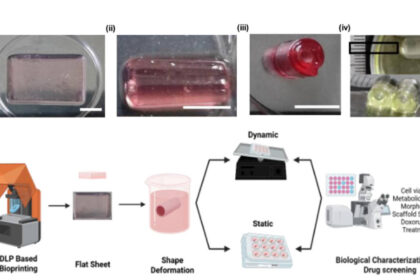
Figure 1. Study design and input series. Triplicate libraries were prepared across a 5–200 ng input range for the OncoSpan (medium quality) and Severe (low quality) reference materials. Deidentified FFPE tissue DNA (not depicted) was evaluated at 40 ng input using both workflows. Libraries were sequenced on an Illumina NextSeq 2000, and analysis was performed using the vendor paired pipelines (Archer Analysis v7.4.2; DRAGEN TruSight Oncology 500 v2.6.0)
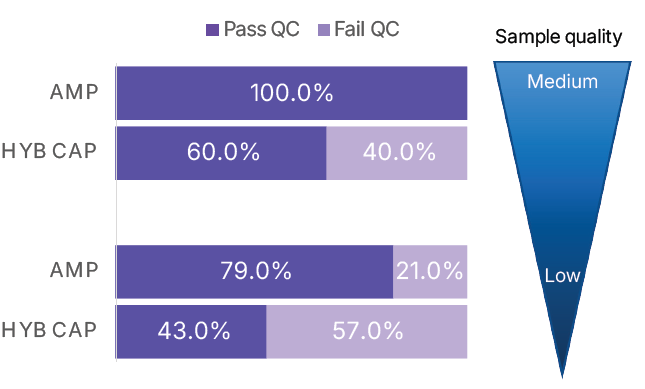
Figure 2. Analytical QC outcomes at low input. Percent of libraries failing analysis QC is shown for OncoSpan and Severe at low input. The figure highlights that hybrid capture exhibits higher QC failure rates than AMP under the lowest input conditions, increasing the likelihood of repeats or workflow switching when DNA is limited.
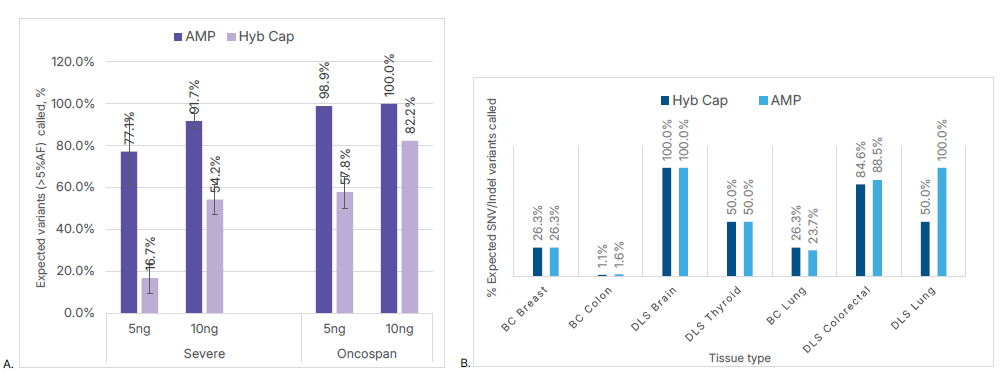
Figure 3. Expected SNV/indel detection across low-input reference materials and 40 ng FFPE tissue DNA. (A) Percent of ddPCR confirmed expected SNV/indel variants (≥5% AF) detected in OncoSpan and Severe reference materials at 5 ng and 10 ng input for AMP (VARIANTPlex) and hybrid capture (TSO500 V1 DNA). (B) Expected SNV/indel calling in deidentified FFPE tissue DNA samples at 40 ng input using the same workflows
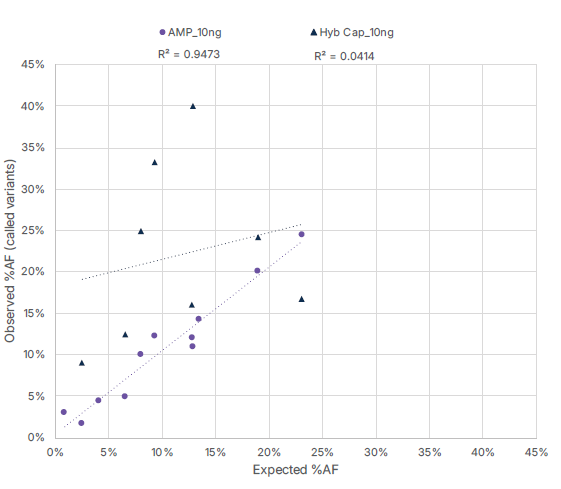
Figure top page 34 – Figure 4. Allele frequency (AF) concordance with ddPCR in the Severe reference at 10 ng input. Expected AFs measured by ddPCR are plotted against observed Afs from AMP (VARIANTPlex) and hybrid capture (TSO500 V1 DNA) for detected variants. The figure highlights tighter ddPCR to observed AF agreement for AMP under low quality, low input conditions