Seoul-based semiconductor company SK hynix Inc. has released plans to build new fabrication facilities in Yongin and Cheongju to respond to the continuously growing demand for memory in the AI era.
The company approved a total investment of approximately 54 trillion, 35.2 trillion won in the Yongin facility and 19.1 trillion won in the Cheongju facility, in a board meeting.
This decision represents execution of the mid-to-long-term investment strategy announced by the company last June. Under its master plan to invest 600 trillion won in the Yongin Semiconductor Cluster and 100 trillion won to expand its Cheongju production base, SK hynix is currently constructing its first facility in Yongin (Y1). With this latest decision, the company is embarking on the construction of subsequent faciities in both Yongin and Cheongju.
According to market research firm Omdia, both DRAM and NAND demand are projected to maintain a compound annual growth rate (CAGR) of 19% from last year through 2030. The company views this growth not as a temporary supercycle, but as a structural transformation in which memory transcends its role as a mere component to become core infrastructure determining AI performance itself.
SK hynix stated that in the AI era, technological competitiveness alone is not enough and the ability to supply the required volume at the exact moment customers need it is the ultimate competitive advantage.
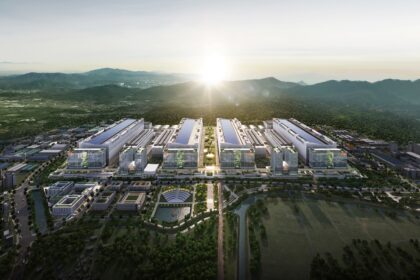
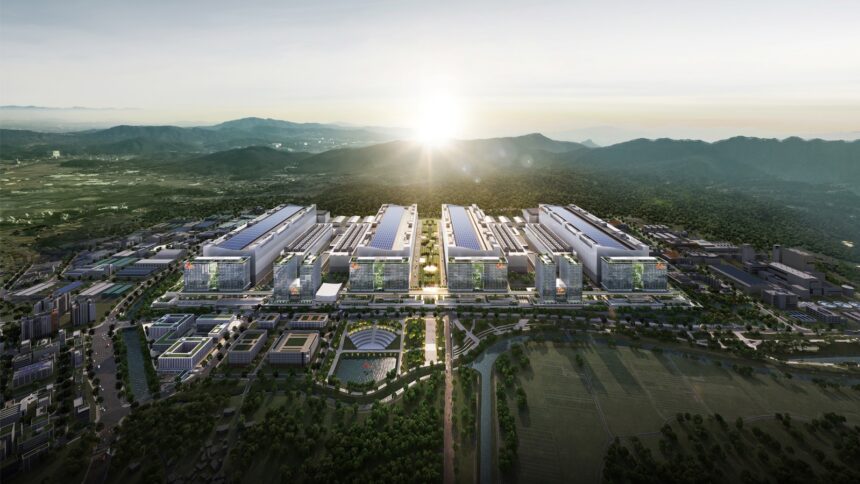
Yongin Y2 is the second of four fabrication facilities planned sequentially for the Yongin Semiconductor Cluster. It will serve as a DRAM production base spanning a total floor area of 341,000 pyeong (approximately 1,130,000m²). Construction is scheduled to start July next year, targeting the opening of its first cleanroom in June 2029 to produce high-bandwidth memory (HBM) and other next-generation DRAM products. Meanwhile, construction on Y1 is progressing smoothly toward its initial cleanroom opening target of February next year.
SK hynix previously set a goal to advance the completion date of the Yongin Semiconductor Cluster by 12 years—from the originally planned 2045 to 2033—to finish constructing all four fabs. The Y2 construction serves as the second phase supporting this accelerated timeline and the investment spans to October 2031 sequentially.
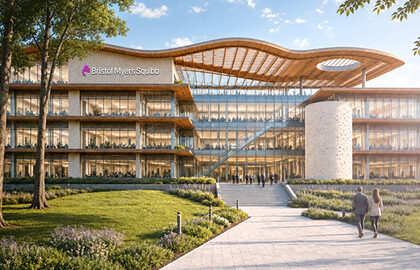
The investment amount includes construction costs for ‘Business Support Building’ with administrative and welfare facilities for Y2 personnel, an ‘Integrated R&D Center’ to consolidate product development testing, analysis, and experiments, as well as auxiliary infrastructure*.
* Auxiliary infrastructure: Water treatment facilities, utility conduits (underground structures capable of accommodating power lines, telecommunications lines, water/sewer pipes, and thermal supply lines), substations, warehouses, etc.
F