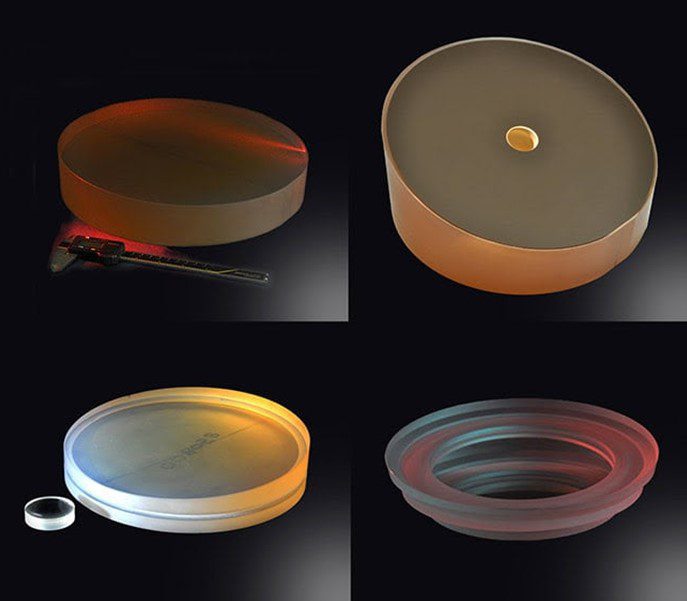
Off-axis parabolic mirrors can now experience below 1nm RMS microroughness
Lens specialist Optical Surfaces has developed a pitch-polishing technique for off-axis parabolic mirrors used as key focussing elements for high-power laser experiments.
"Leading research facilities around the world are deploying petawatt lasers to rewrite our understanding of the cosmos, create nuclear fusion, study fundamental particle physics and even create new matter,” said Dr Aris Kouris, the director at Optical Surfaces.
“To most effectively focus the power from these ultra-high power lasers requires off-axis parabolic mirrors with a surface smoothness at the forefront of what is possible.”
This technique minimises microroughness and controls it at consistently below 1nm RMS, producing ultra smooth mirrors and advancing high-power laser physics.
Microroughness is measured by examining deviations from the mean line profile of a mirror surface. As microroughness becomes more pronounced, it causes effects comparable to mild scattering, which limit the performance of off-axis parabolic mirrors.
Off-axis parabola offer the ability to focus collimated light without experiencing spherical aberration, where the outer parts of a lens do not bring light rays into the same focus as the central part. The mirrors combine the achromatic and diffraction limited imaging properties of a parabolic mirror with the ability to deviate the light path off-axis.
Suitable for broadband or multiple wavelength high power laser applications, an off-axis parabolic mirror encourages more interactive space around the focal point without disrupting the beam.
Earlier this year, Optical Surfaces provided 14 100mm diameter field selector mirrors and a 400mm diameter reference flat to research organisation TNO (Delft, Netherlands) for a laser launch system designed to improve telescope vision with artificial guide stars.